This issue: 131 independent works (91 newly collected / 24 version updates / 16 carried over at the boundary) · Tracks: VLN 8 / embodied agentic navigation 6 · Other directions 117 · WeChat 0
1. Key points
- The language-to-motion interface gains longer physical deployments. WayTrace decomposes map directions into language commands, trace prediction, and control; the paper reports physical missions up to 1.37 km.
- Navigation decisions must address movable obstacles and missing targets. MessyNav reasons about affordances before planning. Object Search verifies existence after retrieval, constraining action and target selection respectively.
- Physical grounding and world modeling require different evidence. Legged-VLN examines constrained execution, while OpenNWM learns dynamics from videos without action labels. Prediction quality does not substitute for navigation success.
2. Deep reads
1. WayTrace
Language connects map directions to long-range motion.
Paper · Track: embodied agentic navigation · Outdoor map guidance / wheeled-legged robot
Problem. Walking directions and GNSS positions do not directly specify reliable street-level motion.
Method. An orchestrator VLM issues atomic commands from directions and recent images. An onboard predictor produces image traces for an RL controller. The layers run asynchronously.
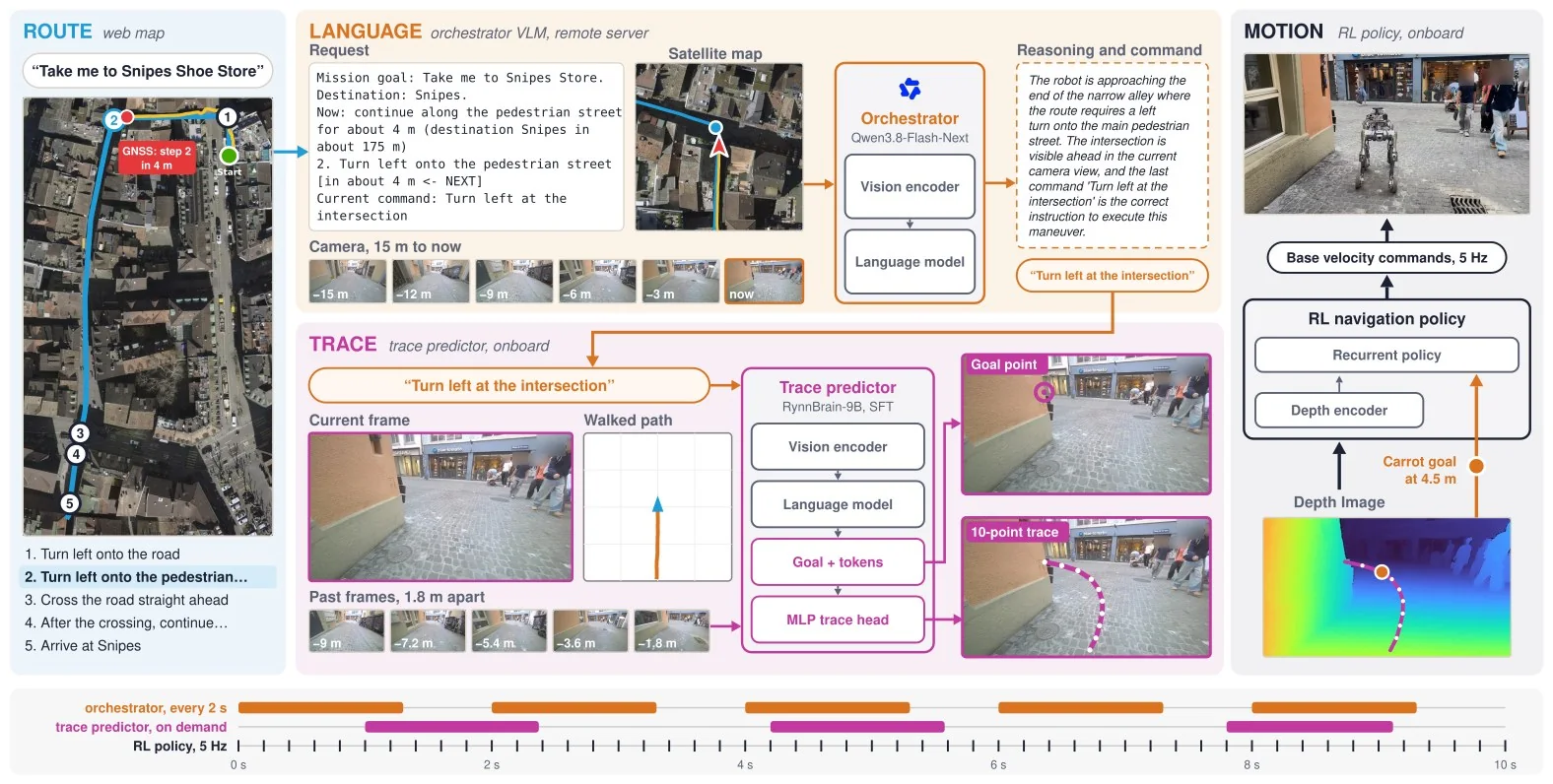

Evidence. Physical missions reach 1.37 km at about 1.1 m/s across crossings, stairs, and construction sites. These are distance and speed, not a standard VLN success rate.
Assessment. Useful for studying planning–control interfaces and waiting. It still uses online maps, GNSS, and a remote VLM; it does not establish localization independence.
Next. Read: classify junction, command-switch, and trace failures, and examine when following the old trace becomes unsafe under latency.
2. MessyNav
Decide whether to move an obstacle before planning passage.
Paper · Track: embodied agentic navigation · Open-world interactive navigation / mobile manipulator
Problem. Physical movability does not imply that interaction is appropriate: a cart carrying fragile objects may need to be avoided.
Method. Explicit affordance reasoning checks feasibility and object safety before a planner sequences navigation, picking, and swiping. Visual grounding resolves object references into 3D positions.
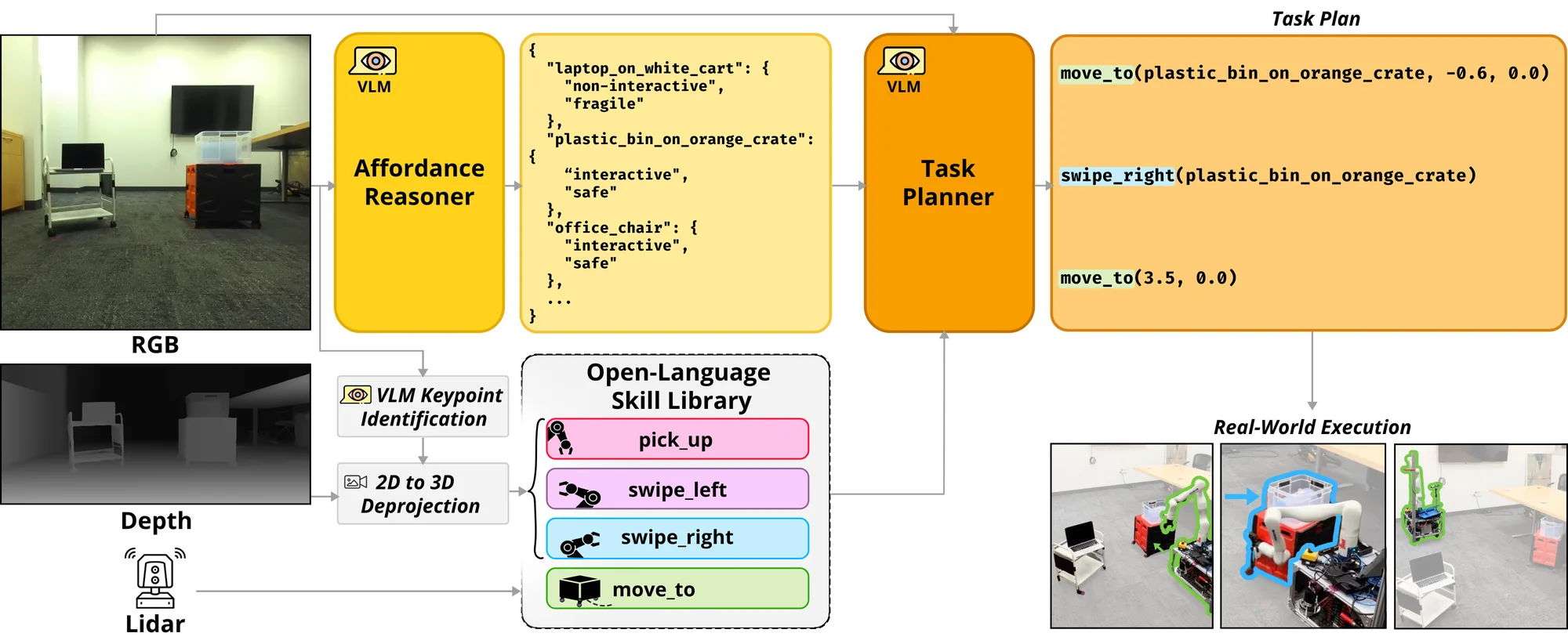

Evidence. The abstract reports a 27-percentage-point physical-robot success gain over the strongest baseline, plus offline evaluation. It omits physical trial counts and the baseline name, so absolute success cannot be inferred.
Assessment. Conditional interaction broadens ground navigation beyond detours. Semantic risk decisions and failures of underlying skills need separate evaluation.
Next. Read: compare explicit affordance reasoning with end-to-end VLM planning, emphasizing hazardous interactions and recovery after failed actions.
3. Legged-VLN
A separate physical layer constrains semantic navigation goals.
Paper · Track: VLN · Humanoid / quadruped language navigation · Physical experiments
Problem. Interpreting language does not itself provide explicit guarantees about robot geometry, obstacle clearance, or motion constraints.
Method. A grounding layer combines state estimation, 3D perception, and an SDF with Bezier-parameterized MPPI and discrete exponential barrier constraints.
Evidence. No quantitative results in the abstract. The authors report humanoid and quadruped experiments and collision-avoidance guarantees under stated assumptions.
Assessment. The separation helps diagnose semantic and execution errors. Guarantees depend on mapping, estimation, and model assumptions; they do not establish collision avoidance in arbitrary dynamic scenes. This is not R2R-CE ranking evidence.
Next. Read: inspect moving-obstacle assumptions and infeasible constraints; compare collisions and stalls with standard MPPI.
4. OpenNWM
Learn dynamics from varied videos, then align physical actions.
Paper · Track: VLN · Navigation world model · Cross-environment prediction and planning
Problem. Action-labeled trajectories offer limited coverage, whereas videos without actions do not directly supervise executable motion.
Method. Latent-action video pretraining is followed by action-conditioned adaptation to physical motion.
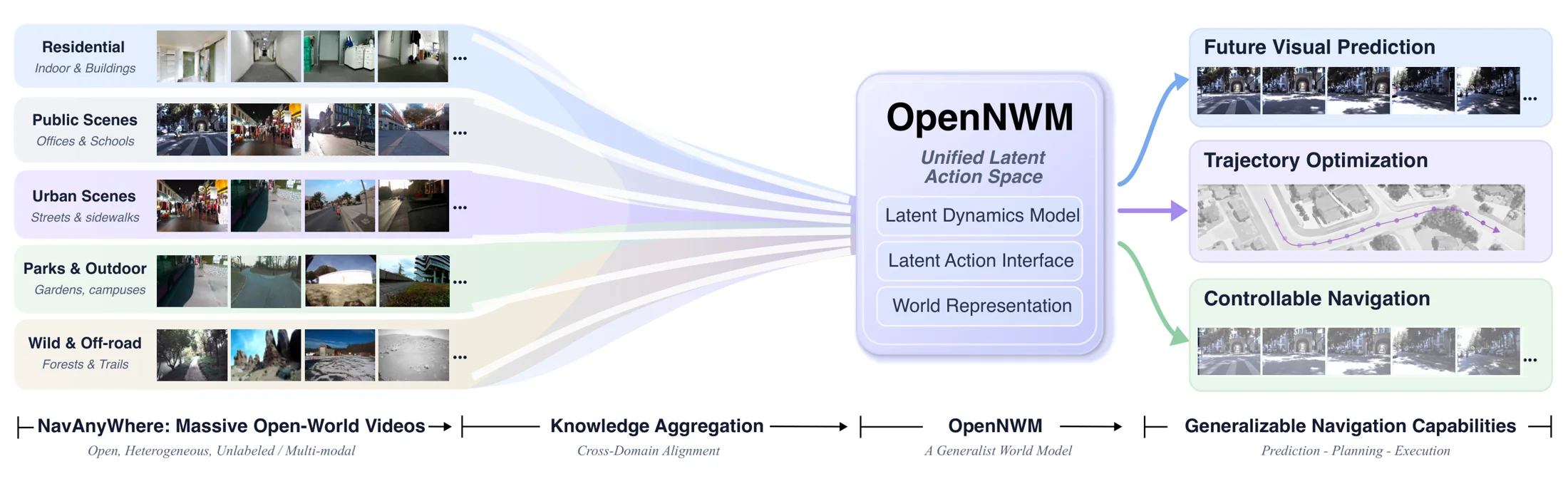

Evidence. NavAnywhere contains 17.5 million visual observations from 15 sources, a data-volume measure. The abstract gives no navigation success rate, only qualitative claims of prediction and navigation gains.
Assessment. Check whether broad experience improves navigation as well as prediction. Separate gains by video source and action alignment, including ground-robot, human, and drone footage.
Next. Read: hold the navigation planner fixed and isolate latent-action pretraining, physical alignment, and data-source contributions.
5. Object Search
Memory retrieval must be able to return target absent.
Paper · Track: VLN · Open-vocabulary retrieval / target selection before navigation · ScanNet
Problem. A most-similar historical frame does not prove that the requested object exists.
Method. Fast retrieval proposes observations; visual verification selects one or abstains. An accepted frame and capture pose guide later search. Paper Figure 1 shows the two stages.
Evidence. On ScanNet apartments, the abstract reports reliability matching or exceeding exhaustive search with an order of magnitude fewer detector calls. It also reports onboard physical-robot operation with one consumer GPU.
Assessment. This supports target retrieval before navigation, not full ObjectNav success. Absence from stored observations must also be distinguished from absence in the current environment.
Next. Reproduce: measure recall, absent-target specificity, and call cost, then introduce moved objects and stale observations.
3. Also worth reading
- Knowing Where to Look · A 3D belief fuses semantic and geometric evidence to select observations, movement, and cabinet interactions.
- HiPer · Persistence from similar instances may inform expiration of navigation memories.
- Graph-swap · Memory-graph swaps may inform diagnostics of whether navigation history is used.
- LIFE · Event-gated observation and writing may inform continuous monitoring in navigation agents.
- ARP · Asynchronous semantic memory and action generation may inform navigation execution.
- VLALagBench · Task- and execution-mode-dependent latency tests may inform navigation runtime evaluation.
- REA · Boundary checks and shared recovery budgets may inform navigation runtimes; principal evidence concerns manipulation.
- RoboCasa-Mem · Earlier behavior defines later constraints, a useful mechanism for testing use of navigation history.
- RESONATE · 8 controller configurations, 8 scenarios, and 5 repetitions yield 320 physical social-navigation experiments.
- EvoLife · Carried over from 10/29: help-seeking, hybrid actions, and persistent place memory.
4. Trends and actions
Trends
- Hierarchical interfaces need explicit failure handling. WayTrace, MessyNav, and REA address command refresh, interaction choice, and policy escalation respectively. Their evaluations are not yet unified.
- Memory evaluation needs abstention, expiration, and counterfactual checks. Object Search, HiPer, Graph-swap, and SPARK address missing targets, moving objects, unused history, and incorrect knowledge respectively.
- Account for data, offline metrics, and deployment gains separately. OpenNWM’s data volume and LoopQ’s hardware findings do not directly establish navigation success or physical-robot speed gains.
Research gaps
- This batch does not jointly validate how wrong target retrieval, stale place memory, and execution failures should trigger revisits or requests for help in long-horizon language navigation.
- A shared task should report route completion, inappropriate interactions, correct stopping, model calls, and waiting time together, so success rate does not hide runtime problems.
Next steps
- High · Read WayTrace and MessyNav: verify task protocols, failure categories, and asynchronous execution boundaries before selecting a component to reproduce.
- High · Reproduce Add absent-target queries and memory-swap diagnostics to navigation evaluation, distinguishing retrieval correctness, memory use, and arrival.
- Medium · Track Legged-VLN and OpenNWM: inspect safety assumptions and downstream gains separately, retaining task-specific evidence.
- Medium · Compare Use the previous issue’s EvoLife help-seeking and place memory as context for target verification and event-triggered mechanisms.
5. Full work index
A marks direct work on the two tracks, B transferable mechanisms or evaluation, and C field observations; 10/29 works are retained for continuity.
VLN and semantic navigation · 8 papers
- Object Search: See deep read.
- OdorSpaces: Combines vision and odor transport for indoor source localization.
- Legged-VLN: See deep read.
- SNAP: Jointly handles semantic terrain and pedestrian dynamics.
- RESONATE: A physical social-navigation testbed with repeated trials.
- OpenNWM: See deep read.
- MOON: Version update; deviation detection triggers clearing and recovery.
- WNM-3D: Version update; 3D scene conditioning for joint view and action generation.
Embodied agentic navigation · 6 papers
- MessyNav: See deep read.
- WayTrace: See deep read.
- Spatiotemporal Memory: Version update; organizes task, temporal, and spatial memories.
- HaltNav: Version update; visual halting revises topology and replans.
- Knowing Where to Look: A 3D belief selects observations, movement, and cabinet interactions.
- EvoLife: From the previous issue: help-seeking, hybrid actions, and persistent place memory.
Transferable mechanisms and evaluation · 32 papers
- Seeing Beyond the Next Step: Distills world-model preferences for social navigation during training.
- LMGN: Couples base placement, approach direction, and grasp stages.
- HiPer: Learns object persistence and updates it after re-identification.
- Generate-then-Rank: Ranks generated symbolic-goal candidates to reduce interpretation errors.
- Criteria Exposure: Tests whether agent scores rely on exposed success criteria.
- When to Ask for Help: Requests aerial sensing according to expected navigation benefit.
- RoboCasa-Mem: Uses earlier behavior to define later constraints and test memory.
- Failure-boundary profiles: Separates decisions to stop from competence to pass.
- Cosmos Interactive Simulation: Streams observations conditioned on actions or external physical state.
- LoopQ: Compares quantization in closed loop with matched weights and engines.
- DiMuRe: Uses diagnosis to select recovery at different levels.
- ARP: Semantic-memory updates and fast actions run asynchronously.
- VLALagBench: Tests latency sensitivity by task, speed, and execution mode.
- HeLM: Event-triggered language memory supports cross-episode manipulation.
- Continual Spatial World Models: Spatial-change history and action outcomes refine predictions.
- Serving Agentic Robot Fleets: Studies action deadlines and long-context serving bottlenecks.
- SCOUT: Checks candidate plans under occlusion with object-centric rollouts.
- Graph-swap: Swaps memory graphs to test whether predictions depend on history.
- PREM: Prediction discrepancy regulates spatial visual-memory updates.
- MOST: Supervises memory with object-state changes and task progress.
- Auriga: Previews motion and checks execution tolerances for local recovery.
- Understanding Embodied Memory: Organizes embodied memory by requirements, architectures, and evidence.
- SPARK: Targeted revisits correct an embodied knowledge base; evaluated on EQA.
- RoboArchitect: Automatically revises a harness around a frozen robot policy.
- REA: Asynchronous routing, boundary checks, and budgeted recovery.
- LIFE: Event gates select observations, memory writes, and tool expansion.
- ID-WM: Separates reachable subgoals from low-level action grounding.
- BioAgent: Validated skills and pre/postconditions govern task progression.
- RoboSeed: Assesses capability, affordability, and reproduction evidence separately.
- LOGIV: Checks physical task dependencies and repairs them locally.
- EmbodiExp: Composes experience through verifiable subgoals and local successes.
- CaPtain: A post-training pipeline organizes robot code-as-policy agents.
Other directions · 85 papers
- Evaluation, recovery, and safety(13):OopsieRecover, AffectiveVLA, CRONOS, Auditing Imagined Rewards, Onboard HJ Reachability, Rollout then Recycle, RoboColosseum, When Delay Meets Drift, Route-Guided CBF-QP Repair for Safe…, ClothDojo, Simulator Contact Audit, Start Suppression, BURGER
- Policies and manipulation(27):SLA, La-JEPA, Concertina, A3-VLA, Astra / RoboMME, NEO-VLA, Action-Token Supervision, RAFT, Text-Action Divergence, PolicyIK, Beyond Policy Patches, AdaIE, ODE Policy, GatedVLA with Camera-Based…, Joint Denoisers, Behavioral Steering, CalVLA, SAFARI, TRACE, Consequence-Grounded Alignment, Gym-Anything, HiFOR, Step-Level Action Value, Planar Loco-Manipulation, UI Planning-Grounding Agent, PRIME W0, Smooth Action Chunking
- Data and skills(10):Proactive Human Intervention, Action Intent as a Bridge, ActOR, Bridging Representation and Action, AceAction-5M, AIRoA-0, MoSoLoco, Imitable Teacher, Demonstration Expansion, TouchBridge
- Driving and aerial robots(6):MotoVerse, Aero-VPA, Scene-Adaptive Readout and Decoding…, STEER, OpenFlyV2, Long-Horizon Dexterity
- Compression and deployment(9):T3R, Calibrated Latent Probing, Kinematic Hypothesis Context, VLA Inference Bottlenecks, Same Path, Less Time, SVD-Prune, Leap-VLA, SACQ, STAR
- Earlier papers with version updates(20):SimForcing, Intent-Conditioned Fine-Tuning, Selected Diffusion Noise, PDRVLA, Pre-Imagined Milestones, Self-Demonstrated Control, Compositional Agentic Robotics, LIBERO-RECOVER, CLAP, DuoBench, VLA Feature Mechanisms, OmniGuide, Neural Geometry, OpenHLM, MAESTRO, ActionFlow, RynnVLA-Latent, Large Discrete Policy, SpecPrune-VLA, Detect and Suppress